

Key takeaways
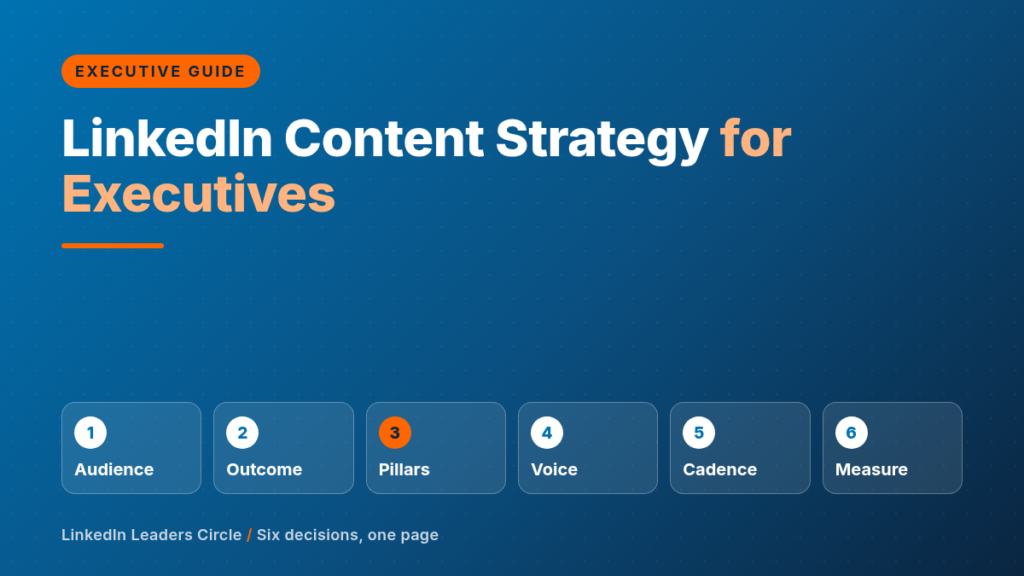
- An executive LinkedIn content strategy settles six decisions: audience, outcome, pillars, formats and voice, cadence, and measurement.
- Pick three to five content pillars you can write about without research and that your audience cares about.
- A cadence you can keep for six months beats a daily burst. Short, regular commenting counts too.
- Judge progress by who is engaging and which conversations start, not by impressions alone.
A good LinkedIn content strategy for an executive is a one-page plan that settles six things in advance: who you are writing for, what you want them to think or do, the three to five topics you will own, the formats that suit you, a cadence you can actually keep, and how you will judge whether it is working. Get those decisions right once and posting stops being a weekly blank page. It becomes a short, repeatable routine that fits around the job you already have.
Full disclosure: LinkedIn Leaders Circle builds content strategies for leaders. This guide is written so you can build your own with it.
What is a LinkedIn content strategy, and what is it not?
A content strategy is the set of decisions that sit behind your posts. It is not a list of post ideas, and it is not a ghostwriter. Those come later and depend on it. Content is also only one part of an executive presence, alongside your profile and your conversations; our guide to LinkedIn for executives shows how the three fit together.
- A strategy answers who, what, why and how often. It changes rarely, perhaps once or twice a year.
- A content calendar turns the strategy into specific posts for the next few weeks. It changes constantly.
- Writing is the production step. You can do it yourself, hand it to your team, or work with a writer. If you are weighing that last option, read what LinkedIn ghostwriting is, and when it is ethical.
Most executives who stop posting skip the first step. They start with ideas, run out of them in a few weeks, and conclude LinkedIn is not for them. The problem was never the ideas. It was that nothing told them which ideas mattered.
Why executives need a different strategy from creators
Most LinkedIn advice is written for people whose job is to grow an audience. Yours is not. That changes the strategy in four ways.
- Your audience is small and specific. A few hundred of the right people (buyers, board members, investors, future hires) matter more than tens of thousands of strangers.
- Your time is the scarcest input. A plan that needs an hour a day will be abandoned by the first quarter-end.
- Your words carry institutional weight. Comments about results, deals, people or regulation can create real problems. You need clear lines on what you will not post.
- The goal is trust, not reach. You want the right person to think, “This is someone who understands my problem,” before you ever meet.
That last point is backed by buyer research. In the 2024 Edelman and LinkedIn B2B Thought Leadership Impact Report, 73% of B2B buyers said thought leadership is a more trustworthy basis for judging a company’s capabilities than its marketing materials, and 86% said they would be moderately or very likely to invite an organization that consistently publishes high-quality thought leadership into an RFP. The same study found only 15% of buyers rate the thought leadership they read as very good or excellent (Edelman, 2024). The bar is low, and consistency plus substance clears it.
The six decisions in an executive LinkedIn content strategy
Work through these in order. Each one should fit in a few lines. If your finished strategy runs past a page, it is probably a calendar in disguise.
1. Audience: name the people, not the market
Write down two or three reader groups by role and situation, not by industry label. “CFOs at private-equity-backed manufacturers preparing for a sale” is useful. “Finance leaders” is not. For each group, note one thing they worry about that you know a lot about. That worry is where your content starts.
2. Outcome: decide what you want people to think or do
Pick one primary outcome for the next six months. Typical choices for executives:
- Be the obvious name when a specific type of buyer starts looking.
- Make recruiting easier by showing how you lead and what the team is building.
- Build credibility with investors, partners or a board ahead of a raise, a launch or a transition.
- Support the company’s sales team by giving prospects a person to trust, not only a brand.
One outcome keeps topics focused. Three outcomes at once usually produce posts that serve none of them.
3. Pillars: the three to five topics you will own
Content pillars are the recurring themes people should associate with you. Good executive pillars pass three tests:
- Depth: you could write ten posts on it tomorrow without research.
- Relevance: your audience from step 1 cares about it.
- Ownership: you have a view, a story or a method on it that others in your field do not share.
A common, workable mix is one pillar on your area of expertise, one on the market or industry you see from your seat, one on how you lead or build, and one more personal pillar (lessons, mistakes, what you are learning). Keep promotional content as a thin slice, not a pillar.
4. Formats and voice: how you sound and what you publish
Choose formats you can produce without strain. If you think out loud well, short text posts drafted from voice notes suit you. If you think in frameworks, a document post or carousel may be easier. If you are comfortable on camera, short video is an option, but nobody should be forced into it.
Then write a short voice guide. Three lists are enough: words and phrases you use, words you would never use, and topics that are off limits (client names, financial results before they are public, anything legal or HR-related). This guide is what lets someone else draft for you later without sounding like a stranger.
5. Cadence and workflow: a rhythm you can keep
There is no single right number of posts. A cadence you hold for six months beats a burst of daily posts that stops in three weeks. Start with what your calendar can absorb, then build the workflow around it. Here is one example of a weekly rhythm for a busy executive; adjust the time blocks to your week.
| When | What | Time |
|---|---|---|
| Monday | Capture: jot or voice-record two or three ideas from last week’s meetings, deals or questions you were asked | 15 minutes |
| Tuesday | Draft or review: write one post, or review a draft prepared from your notes | 20 to 30 minutes |
| Wednesday to Thursday | Publish, then stay nearby for the first hour to reply to comments | 10 minutes |
| Most days | Comment thoughtfully on two or three posts from people in your audience | 10 minutes |
| Friday | Glance at what landed and what did not; note one idea for next week | 5 minutes |
Commenting matters more than most executives expect. A considered comment on a buyer’s or peer’s post is often seen by exactly the people you want to reach, and it costs a few minutes.
6. Measurement: judge it by who, not how many
LinkedIn gives every member post analytics. Beyond impressions, you can see members reached, profile viewers from a post, followers gained, and viewer demographics such as job title, company, seniority and industry, though LinkedIn notes these are estimates and demographics only appear once enough people have viewed a post (LinkedIn Help).
For an executive, the useful questions are:
- Are the job titles and companies in my viewer demographics the ones from step 1?
- Which posts sent people to my profile?
- Who commented, and are any of them people I would like to talk to?
- Did any conversation start (a message, a meeting request, an introduction, a mention in a sales call)?
Keep a simple monthly log of those answers. After three months you will know which pillars earn attention from the right people, and you can drop the ones that do not.
An example strategy on one page
This is a fictional example written for illustration. It is not a client.
| Decision | Example: COO of a mid-sized logistics company |
|---|---|
| Audience | Operations and supply chain leaders at retailers and manufacturers; potential senior hires |
| Outcome | Be the operator buyers think of when they are fixing fulfilment problems |
| Pillars | 1) What actually breaks in a warehouse; 2) Reading the freight market from the inside; 3) Leading frontline teams; 4) Lessons from projects that went wrong |
| Formats | Short text posts from voice notes; an occasional document post that turns a checklist into slides |
| Voice | Plain, specific, a little dry. Never: “game-changer,” customer names, unreleased numbers |
| Cadence | Two posts a week, comments most mornings, one longer piece a month |
| Measure | Viewer job titles, profile views from posts, conversations started, hires who mention the posts |
Notice what is missing: follower targets, viral hooks and a posting streak. None of those serve the outcome.
Mistakes that stall executive content
- Starting with tactics. Hooks and formatting tricks do not help if nobody knows what you stand for.
- Too many pillars. Seven themes means no theme. Cut to the three to five you can sustain.
- Posting only announcements. Company news has its place, but a feed of press releases gives readers no reason to follow a person.
- Letting a profile lag behind the content. A good post sends people to your profile. If it describes the job you had three years ago, the trail goes cold. Our guide to LinkedIn profiles for executives who are not job hunting covers that side.
- Outsourcing the thinking. A writer can save you hours, but the ideas, stories and opinions have to be yours. Approval on every post should stay with you.
- Judging it in week three. Trust builds slowly. Review monthly and adjust quarterly.
How to get started this week
You can produce a first version of your strategy in about an hour. Block the time now.
- Write your audience line. One sentence each for two or three reader groups, with one worry per group.
- Pick one outcome for the next six months and write it at the top of the page.
- List ten questions clients, candidates or peers asked you in the last month. Group them. The groups are your first draft of pillars.
- Write your voice guide in three short lists: words you use, words you never use, topics that are off limits.
- Choose a cadence you can keep for six months, even if it is one post a week, and put the capture and drafting blocks in your calendar as recurring meetings.
- Draft your first post from the strongest question on your list. Answer it the way you would in a meeting.
- Check your profile so it matches what you are about to post about. The LinkedIn Presence Score quiz takes a few minutes and shows where your presence is weakest.
How LinkedIn Leaders Circle helps
If you would rather not build this alone, our LinkedIn content strategy service (one of our LinkedIn services) does it with you. It starts with a 90-minute strategy session, by phone or video, where we work through your audience, goals, expertise and the stories you are willing to tell. You leave with a written strategy (audience, three to five pillars, a voice guide, a format mix and a cadence) and a 30-day content calendar with specific post ideas.
After that you can run it yourself, hand it to your team, or hand it to us for writing and monthly management, where nothing is published without your approval. About LinkedIn Leaders Circle explains how we work, and what’s included covers one-time and monthly engagements. To get a feel for how we write in different leaders’ voices, browse our sample posts.
Frequently asked questions
What is a good LinkedIn content strategy for an executive?
A short written plan that defines your audience, the outcome you want, three to five content pillars, the formats and voice that suit you, a cadence you can keep, and how you will measure progress. It should fit on one page and change only once or twice a year.
How often should an executive post on LinkedIn?
There is no single right number. Consistency and substance matter more than volume, so choose a cadence you can sustain for at least six months, even if that is one post a week, and add a few minutes of thoughtful commenting on most days.
How much time does an executive LinkedIn strategy take each week?
It depends on how much you write yourself. If you capture ideas, review drafts and reply to comments while someone else drafts, the weekly commitment can be modest. Writing every post yourself takes considerably more. Build the plan around the time you actually have.
Can someone else run my LinkedIn content strategy for me?
Yes, as long as the ideas and approval stay with you. A writer or team can turn your strategy and voice guide into drafts, but you should approve every post before it goes live, and the opinions should be your own.
Ready to stop starting from a blank page?
Book a free 30-minute discovery call, by phone or video, and we will talk through where you are on LinkedIn today and what a strategy would look like for you. Not ready to talk yet? Take the LinkedIn Presence Score quiz first.

We write and manage LinkedIn profiles, posts and outreach for founders, executives and businesses who want to grow on LinkedIn but don't have the time to do it themselves. About us