


Key takeaways
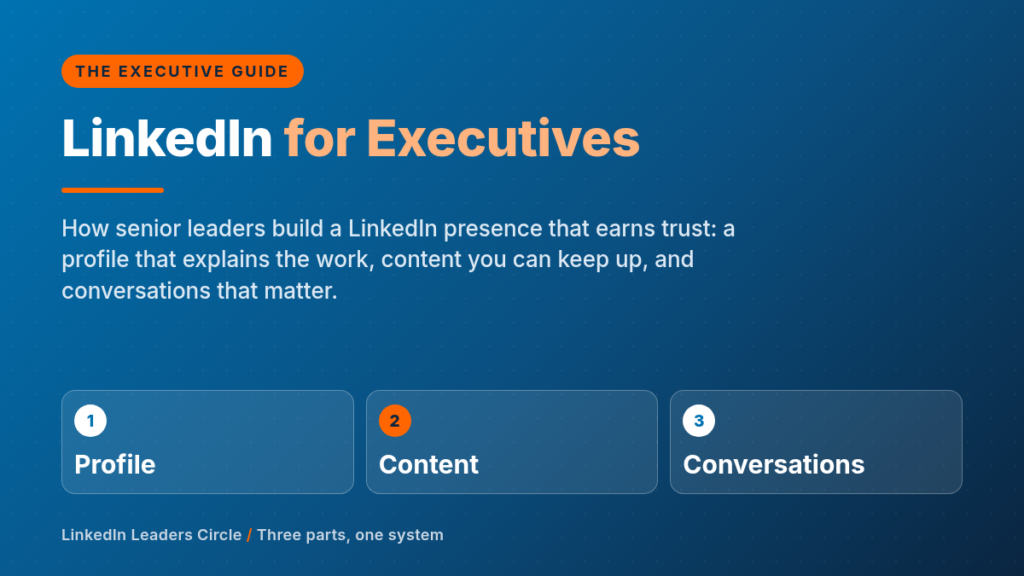
- Treat LinkedIn as three connected assets: your profile, your content and your conversations.
- Write your profile for the people you want to reach, not for recruiters. Put the most important words first in your headline.
- A short content plan with three to five topics and a cadence you can keep beats bursts of posting.
- Conversations create the opportunities: connect with a reason, never pitch in the first message, and follow up where attention already exists.
Executives should treat LinkedIn as three connected assets, not a social feed: a profile that says what you do now and for whom, a small amount of regular content on topics you genuinely own, and deliberate conversations with the specific people your goals depend on. Each part makes the others work. Set the profile up once, then give the content and conversations a fixed slot each week, and LinkedIn becomes a reputation you control instead of a chore you avoid.
Full disclosure: LinkedIn Leaders Circle runs LinkedIn for leaders. This guide is written so you can do it yourself if you prefer.
Why LinkedIn matters more for executives than it used to
Before a prospect takes your call, before an investor replies, before a senior candidate accepts an interview, they look you up. Your LinkedIn profile is usually one of the first things they find. Whatever it says, it is already doing a job for you every day. The only question is whether it is the right one.
LinkedIn’s own research points the same way. In a survey published in November 2026, 80% of founders said they have had to become content creators, using their personal brand to build credibility and reach, and 84% said their personal brand adds direct credibility to their business. The same release found 79% of US small business owners expect a strong professional network to become more valuable as AI takes on more of their work (LinkedIn News, November 2026).
None of this means you need to become an influencer. It means the people deciding whether to trust you are checking, and an out-of-date presence sends a signal of its own.
The three-part system: profile, content, conversations
Executives who give up on LinkedIn usually started in the middle. They posted a few times, sent readers to a stale profile, never followed up with anyone who engaged, and stopped. The three parts only work together.
| Part | Its job | How often you touch it |
|---|---|---|
| Profile | Tells anyone who looks you up what you do, who you do it for, and why you are credible | Set up properly once; review once or twice a year or when your role changes |
| Content | Shows how you think, so the right people remember you before they need you | A cadence you can keep, even one post a week, plus a few minutes of commenting |
| Conversations | Turns attention into relationships: buyers, partners, investors, hires, peers | A short, regular block each week |
Part 1: An executive profile that works when you are not job hunting
Your profile should read like a briefing for the people you want to reach, not a résumé for a recruiter. Lead with the problems you solve and the scope you carry, back it with proof you can stand behind, and give a clear next step. Our deeper guide to LinkedIn profiles for executives who are not job hunting covers each section in detail. Here is the short version.
Headline: say what you do and for whom
The headline travels further than any other line on your profile. LinkedIn says it appears under your name in search results, when you send an invitation to connect, when you comment on a post, and in Who’s Viewed Your Profile. You get up to 220 characters, but LinkedIn notes the headline may be cut short in some places, so the most important words belong at the start (LinkedIn Talent Blog).
A useful pattern is role, then the outcome you are known for, then the audience. For example (fictional): “CEO, freight analytics company | Helping mid-market shippers cut freight costs without new software.” Compare that with a line of three titles and a slogan. The first tells a stranger whether to keep reading. The second does not.
About: your point of view, not your biography
Open with the problem you care about or the belief that shapes your work. Then cover what you and your company do, who it is for, two or three pieces of proof (only numbers and results you can verify), and how people should reach you. Write it in the first person. Keep paragraphs short, because only the opening lines show before readers click to see more.
Experience: scope and decisions, not duties
For your current role, describe the size of what you are responsible for, the decisions you own and the outcomes you have driven. One tight paragraph and a few specific bullets beat a list of everything you have touched. Older roles can be brief. Every number should be yours and accurate.
Featured, photo, banner and verification
- Featured: pin two or three things you want a visitor to see first, such as a talk, an interview, a strong post or your company’s key page.
- Photo: recent, clear and recognizably you. LinkedIn’s guidance is a well-lit, high-resolution headshot where your face fills most of the frame.
- Banner: a simple visual cue about your work or company. It does not need to be clever.
- Verification: LinkedIn describes its verification badge as confirming details such as your identity or workplace, which signals authenticity and adds credibility (LinkedIn Talent Blog). It takes a few minutes and is worth doing.
Part 2: Content that builds trust without taking over your week
Content is how the right people come to know how you think before they ever meet you. For an executive, the goal is trust with a specific audience, not reach for its own sake. That means a short written plan, three to five topics you can talk about without research, and a cadence you can hold for six months.
The plan settles six decisions: audience, outcome, content pillars, formats and voice, cadence, and measurement. We walk through each one, with an example, in our LinkedIn content strategy guide for executives. A few principles matter most at the senior level:
- Write from your seat. The posts that work for executives come from what they see that others do not: patterns across customers, hard calls, lessons from projects that went wrong. Generic advice is everywhere already.
- Keep promotion thin. Company news has a place, but a feed of announcements gives readers no reason to follow a person.
- Comment as well as post. A considered comment on a buyer’s or peer’s post reaches exactly the people you care about and takes a few minutes.
- Own the ideas even if you do not type them. Many leaders work with a writer. That can be entirely honest, provided the ideas, stories and opinions are yours and you approve every post. We explain where the line sits in what LinkedIn ghostwriting is, and when it is ethical.
Part 3: Conversations with the people your goals depend on
Profiles and posts create attention. Conversations create opportunities. Most executives skip this part, and it is usually where the value is. The aim is a steady stream of genuine exchanges with people who matter to your next twelve months, not a large network.
Build a short list of the people who matter
Write down, by name where you can, the people who would change your year: target buyers, potential partners, investors, board candidates, senior hires, respected peers. Keep it to a list you can actually track, then sort it three ways: already connected, shared connection or context, and cold.
Connect with a reason, not a pitch
When you send a connection request, a short note that explains the context helps the other person decide. Mention where you met, a post of theirs you found useful, or the shared problem you both work on. Do not pitch in the request or in the first message after they accept. That single habit separates executives who build relationships from those who get ignored.
Example note (fictional): “Enjoyed your post on carrier consolidation. We are wrestling with the same question on our side. Would be good to stay connected.”
Follow up where attention already exists
- Comments on your posts: reply to every thoughtful one. If someone on your list comments twice, that is an opening for a short private message.
- Profile viewers: check Who’s Viewed Your Profile weekly. A relevant viewer is often worth a light, no-pressure hello.
- Moments: job changes, funding news, a new product. A brief, specific note of congratulations is a natural reason to reconnect.
If you want this done systematically for a defined market, that is what a LinkedIn lead generation campaign is for: an ideal client definition, a researched list and personal messages in your voice, without bots or purchased lists.
Guardrails every executive should agree before posting
Your words carry the weight of your company. A one-page set of guardrails keeps you out of trouble and makes it far easier to delegate drafting. Agree it with your communications, legal or compliance lead if you have one.
- Off-limits topics: unreleased financial results, deals in progress, client names without permission, personnel matters, anything in active litigation.
- Regulated industries: if you work in financial services, healthcare or another regulated field, confirm what review your posts need before you start, not after.
- Approval: nothing goes live in your name without your sign-off, whoever drafts it.
- Tone in hard moments: decide in advance whether you will post during layoffs, incidents or market shocks, and who you will check with first.
- Response rules: how you will handle critical comments, and when a reply should move to a private message or offline.
A weekly rhythm that fits around the job
Here is one example of a week for a busy executive once the profile is in shape. Adjust the blocks to your calendar; the point is that each part gets a small, fixed slot.
| When | What | Part |
|---|---|---|
| Monday, 15 minutes | Note two or three ideas from last week’s meetings, deals or questions you were asked | Content |
| Tuesday, 20 to 30 minutes | Write one post, or review a draft prepared from your notes | Content |
| Midweek, 10 minutes | Publish, then reply to comments in the first hour or so | Content and conversations |
| Most mornings, 10 minutes | Comment thoughtfully on two or three posts from people on your list | Conversations |
| Friday, 15 minutes | Check profile viewers and new connections; send two or three personal follow-ups | Conversations |
How to tell if it is working
Skip the vanity totals. Log the answers to these questions once a month:
- Are the people viewing my profile and posts the job titles and companies I am trying to reach?
- Which posts sent people to my profile, and which topics drew comments from people on my list?
- How many real conversations started this month: messages, meeting requests, introductions?
- Did LinkedIn come up in a sales call, a board conversation, an investor meeting or an interview?
After a quarter you will know which topics and habits earn attention from the right people. Keep those and drop the rest.
Mistakes that keep executives invisible
- Treating the profile as a résumé. It lists titles and dates but never says what you are trusted to do now.
- Posting in bursts. Five posts in a week, then silence for two months. Consistency beats intensity.
- Broadcasting without engaging. Posting and leaving, never commenting or replying, tells people you are not really there.
- Pitching in the first message. It burns the relationship before it starts.
- Outsourcing the thinking. A writer can save you hours. Your opinions cannot be delegated.
How to get started today
You can make real progress in under an hour. Do these in order.
- Look yourself up as a stranger would, in a private browser window. Note the first three things that feel out of date.
- Rewrite your headline using role, outcome and audience. Put the most important words first.
- Write the first two lines of your About section so they state the problem you solve and who you solve it for.
- Pick three topics you could write about tomorrow without research. Those are your first content pillars.
- Write down ten names of people who would change your year if you were in conversation with them, and check which you are already connected to.
- Put two recurring blocks in your calendar: one for content, one for conversations. Fifteen to thirty minutes each is enough to begin.
- Take the LinkedIn Presence Score quiz. It takes a few minutes and shows which of the three parts is weakest, so you know where to start.
How LinkedIn Leaders Circle helps
We work with executives, founders, VCs and consultants who want a strong LinkedIn presence without giving it hours a week. Our LinkedIn services map to the three parts in this guide: a profile rewrite for the profile, a content strategy and ghostwriting for the content, lead generation campaigns for the conversations, and monthly done-for-you management if you want all of it handled.
Everything is written in your voice from your ideas, and nothing is published or sent without your approval. About LinkedIn Leaders Circle explains how we work, and what’s included covers one-time and monthly engagements. If you are not sure which part to fix first, that is exactly what the discovery call is for.
Frequently asked questions
How should executives use LinkedIn?
As three connected assets: a profile that explains what you do now and for whom, regular content on a few topics you genuinely own, and deliberate conversations with the people your goals depend on. Set the profile up once, then give content and conversations a short, fixed slot each week.
How much time does LinkedIn take for a busy executive?
It depends on how much you write yourself. Once your profile is in shape, a small amount of time across the week for capturing ideas, reviewing a post, commenting and following up is a realistic start. Choose a rhythm you can keep for six months rather than an ambitious one you will drop.
Should a CEO post on LinkedIn personally or leave it to the company page?
Both have a role, but people tend to follow people. A company page is good for official news and hiring. A leader’s personal profile is where judgment, perspective and relationships come through, which is usually what buyers, investors and candidates want to see.
Is it acceptable for someone else to write my LinkedIn posts?
Yes, if the ideas, stories and opinions are yours and you approve every post before it goes live. A writer helps you say what you think clearly and consistently. They should never invent experiences or views on your behalf.
What should executives avoid posting on LinkedIn?
Unreleased financial results, deals in progress, client names without permission, personnel matters and anything in active litigation. If you work in a regulated industry, agree a review process with compliance before you start.
Ready to make LinkedIn work for you?
Book a free 30-minute discovery call, by phone or video, and we will look at where you are on LinkedIn today and which of the three parts to fix first. Not ready to talk yet? Take the LinkedIn Presence Score quiz first.

We write and manage LinkedIn profiles, posts and outreach for founders, executives and businesses who want to grow on LinkedIn but don't have the time to do it themselves. About us